
- Overview
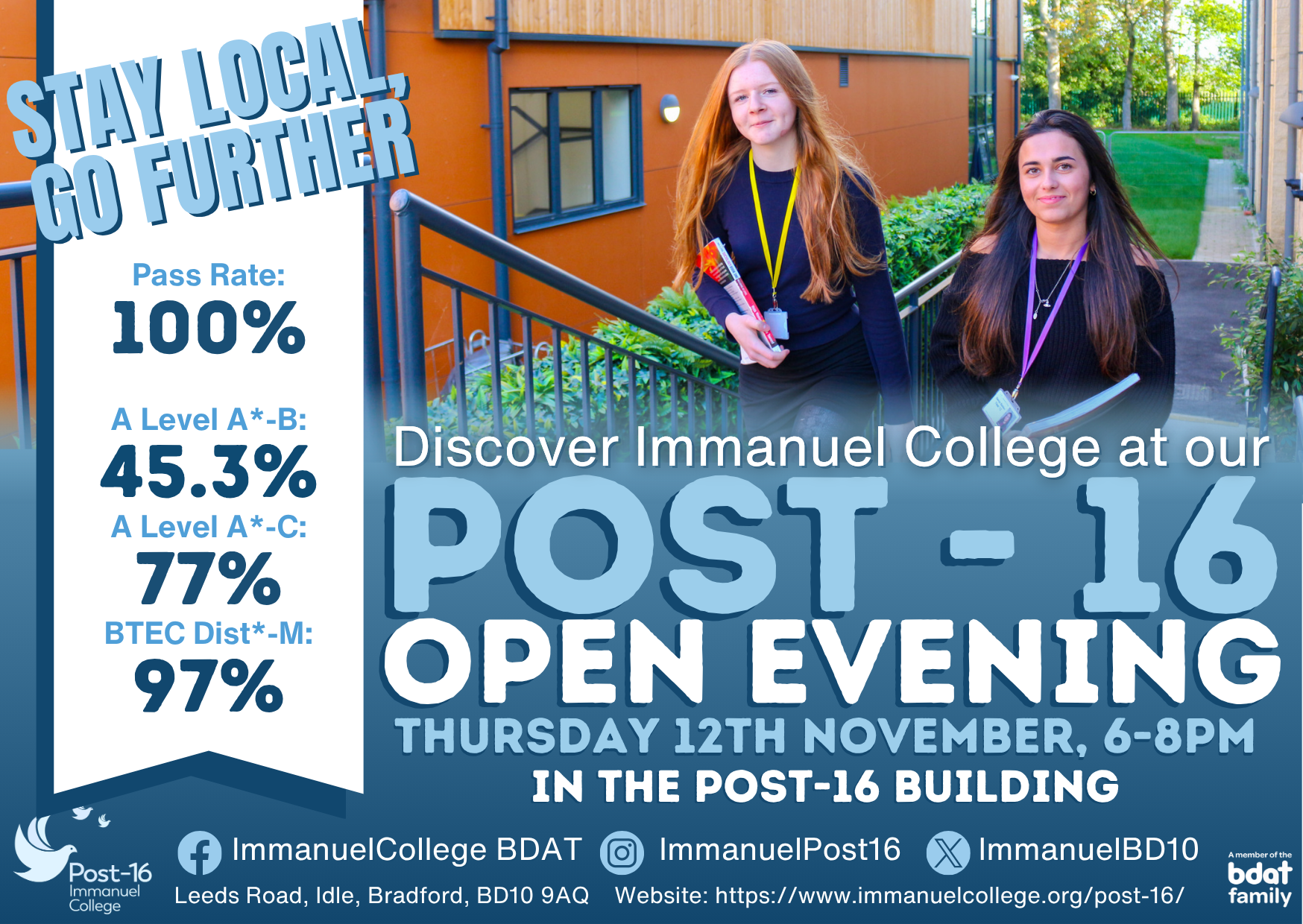
- Open Evening
- Welcome from the Headteacher
- Post-16 Team
- Admissions
- Post-16 Prospectus
- Subjects
- English Language & Literature
- English Literature
- Maths
- Biology
- Chemistry
- Physics
- Applied Science (Applied General)
- Art
- Art: Textile Design
- Business (Level 3 - Extended Certificate)
- Computer Science
- Criminology (Applied General)
- Digital Media (Applied General)
- Drama & Theatre
- Economics
- Film Studies
- Geography
- History
- Law
- Law (Applied General)
- Media Studies
- Music (Applied General)
- National Extended Certificate in Uniformed Protective Services (Applied General)
- Philosophy, Theology, Ethics - Religious Studies
- Photography
- Psychology
- Sociology
- Sport (Applied General)
- Statistics
- Travel and Tourism (Applied General)
- Hospitality (Level 2)
- Leadership through Sport (Level 2)
- Public Services (Level 2)
- Employability
- Maths and English GCSE Resit
- Student Leadership
- Results & Student Progression
- Trips & Opportunities
- Pilgrimage 26
- Oxford University 26
- Auschwitz 26
- Thailand 26
- Turner Prize Exhibition
- Beckets Park University
- Climate Change Conference
- Robin Hood's Bay 25
- Pilgrimage 25
- University of Leeds Open Day
- Go Higher Leeds Trinity
- Brazil 25
- Parker Engineering Project 2025
- London 2025
- Pilgrimage 2024
- Vietnam 2024
- Paris 2024
- Pilgrimage 2023
- Thailand 2023
- Cambridge 2023
- Auschwitz 2023
- Oxford 2022
- Charity Work
- Facilities
- Enrichment
- FAQs
- Exams Information
- Go Higher West Yorkshire
Statistics
Why choose this subject?
Can you predict the future using data? How do we know whether statistics are telling the truth?
Statistics is everywhere! From predicting sporting results and analysing medical research to understanding social media trends and making business decisions, statistics helps us make sense of the world around us.
Have you ever wondered:
- How do scientists know whether a new medicine actually works?
- Can statistics predict the winner of a football match?
- How can opinion polls predict the views of millions of people?
- How do businesses use data to understand their customers?
By studying A Level Statistics, you will develop the skills to investigate these questions, recognise misleading information and use evidence to make informed decisions.
If you enjoy working with numbers, solving real-world problems and understanding how the world works, Statistics could be the perfect subject for you!
What will you study?
-
Data analysis and presentation: Explore how data is collected, organised and presented. Learn to interpret graphs, calculate averages and measures of variation, and identify misleading statistics.
-
Probability and distributions: Investigate the mathematics behind chance and uncertainty, including the binomial, normal and Poisson distributions, to model real-world situations.
-
Correlation and regression: Discover how relationships between variables can be identified and used to make predictions, while understanding the limitations of these predictions.
-
Hypothesis testing: Learn how scientists and researchers use statistical evidence to test claims and decide whether results are significant or could have occurred by chance.
-
Sampling and experimental design: Explore how surveys, experiments and research studies are designed to produce reliable and meaningful results.
-
Statistics in practice: Apply your knowledge to real-world data, evaluate statistical investigations and draw informed conclusions.
Unlike A Level Mathematics, which includes substantial pure mathematics and mechanics, A Level Statistics focuses on the practical application of statistical techniques and interpreting evidence.
How is this course assessed?
The Pearson Edexcel A Level Statistics qualification is assessed through three examinations taken at the end of the two-year course.
-
Paper 1 – Data and Probability
-
Focuses on interpreting data, probability, statistical distributions and mathematical modelling.
-
-
Paper 2 – Statistical Inference
-
Explores hypothesis testing, statistical investigations, sampling and drawing conclusions from data.
-
-
Paper 3 – Statistics in Practice
Brings together knowledge from across the course, applying statistical techniques to real-world problems and investigations.
Each examination lasts 2 hours, is worth 80 marks and contributes equally to the final A Level grade.
There is no coursework. Students will be regularly assessed throughout the course to monitor progress and develop confidence in applying statistical techniques.

Maths Intent
The intent of the mathematics curriculum has at its heart, our values of perseverance, character and hope, which promote a sense of belonging in the world of Mathematics1.
The mathematics curriculum at Immanuel College is designed to ensure that all students have a secure knowledge base and cultivate a deep understanding of mathematical concepts and procedures, as well as the ability to apply these to a variety of problems, including those they may face in the real world3.
The mathematics department models and promotes mathematical rigour.
The curriculum is designed to foster students' mathematical reasoning skills, their ability to communicate mathematical ideas effectively, and their appreciation of the beauty and power of mathematics7.
Students are stretched and challenged.
We create a positive learning environment with high expectations where students thrive and reach their hopes and aspirations.
We promote diversity within the curriculum and show case that mathematicians both historically and locally come from all kinds of backgrounds and upbringing.
Students are prepared for future studies in mathematics: The curriculum provides a solid foundation in mathematics for students who wish to study mathematics at university or in other advanced programs9.
1 Matthew 1:23 – ‘They will call him, “Immanuel” which means “God with us.”
3 Galatians 3:26 – ‘In Jesus you are all children of God through faith.’
7 Ephesians 2:10 – ‘For we are God’s masterpiece, created in Christ Jesus to do good works which God prepared in advance for us to do.’
9 John 10:10 – Jesus said, ‘I have come that they may have life and have it abundantly.’
What next?
Statistics is an increasingly valuable qualification in a world driven by data, research and technology.
A Level Statistics develops analytical thinking, problem-solving, research and decision-making skills that are highly valued by universities and employers.
It complements subjects including Psychology, Biology, Geography, Business Studies, Economics and Sociology.
Students may progress to degree courses in areas such as psychology, economics, business, biological sciences, social sciences and sports science, subject to individual university entry requirements.
Statistical skills are also valuable in careers including:
-
Data analysis and data science
-
Medicine and healthcare research
-
Finance, banking and economics
-
Business and marketing
-
Sports performance analysis
-
Scientific research
In a world full of information, Statistics gives you the skills to question it, understand it and use it.